In recent years, much has been made of the proliferation and use of digital tools to enable patient identification and matching to clinical trials. But within the everyday world of a busy investigator site, how useful are these tools?
In this case study we examine a real-world, practical example of the significant time and resource savings that can be gleaned by the application of such tools.
THE CHALLENGE COHORTS
For an observational multi-center cohort study on metastatic hormone-sensitive and castration-resistant prostate cancer, a database was created capturing patient characteristics, disease features, clinical outcomes, and healthcare utilization insights through chart review. To date, 19 centers have been included to create a national “Real World Data” registry, with the number of participating hospitals increasing annually.
19 HOSPITALS
Data for this multi-center study were previously collected manually, a time-consuming and costly task. In addition, the data captured only reflected a snapshot in time. To update insights, manually re-gathering data per hospital would be required, which limited the speed and scope of the study. A suitable alternative to this time-consuming, error-prone, and irregular process of manual data collection was sought.
THE SOLUTION
The use of digital patient-finding technology enabled the automation of the data collection process. Data could be collected simultaneously from multiple hospitals through a process that adhered to all data privacy considerations. The deployed technology was able to search through both structured and unstructured Electronic Health Record (EHR) data. Natural Language Processing algorithms (NLP), embedded in the technology, extract the medical concepts and measurements from the clinical notes and pseudonymize the data. After this, the data from various sources is harmonized and loaded into the database.
The search set-up (query) was refined and
improved several times during the project, based on characteristics and
symptoms of the patients already identified.
Figure 1: IQVIA, Navigating Treatment Outcomes, 2023
THE OUTCOME IMPACT ON HEALTHCARE
Provide faster, more effective and
continuous feedback to healthcare providers about their care delivery and its
impact on the treatment of patients.
WIDER INSIGHTS
As well as gaining rapid, accurate insights
into clinical outcomes and complications, the cost-effectiveness of treatments
can be determined for the cohort.
ACCURACY ASSURANCE
Greater assurance about collecting an
accurate, error-free and complete set of data in the cohort database was
obtained by:
• A direct download from the Electronic
Health Record (EHR) instead of manually retyping data
• Automatically unlocking all relevant data
fields, which often does not happen during manual searches
HEALTHCARE COSTS
As well as gaining rapid, accurate insights
into clinical outcomes and complications, the cost-effectiveness of treatments
can be determined for the cohort.
TIME-SAVING
Not only is this way of searching faster
than manual searching, it is less error-prone, more data can be found and the
data provided is of a higher quality.
THE NUMBERS
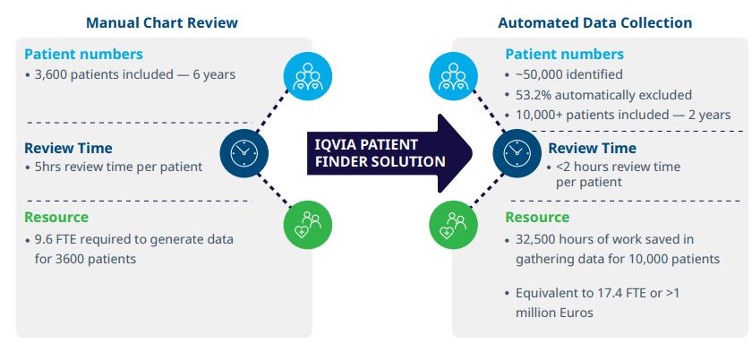
• A registry of 10,000+ patients generated
in less than 2 years
• Reduction of patients that needed to be
screened for inclusion by 53.2%
• Completeness and accuracy of automated
data extraction 92.3% or higher
• Identification, validation and completion
of extracted data in 105 minutes per patient with patient finding technology,
versus 300 minutes during the manual process (65% time saved)
• 32,500 hours of work saved, corresponding
to 17.4 FTE and 1,023,333 euros saved
THE USER OUTCOME
“By using this software, we can find patients and collect their data much faster than is possible with manual data collection. This allows us to give the information back to healthcare professionals and society faster, to improve patient healthcare.” — Principal Investigator
“Before using this software, it took five hours per patient to manually transfer all the data into this database. By automating data collection, huge time savings were made, it now takes less than two hours per patient.” — Principal Investigator
For a more detailed examination of the benefits of this technology, IQVIA has published a white paper, “Finding All the Needles in the Haystack;’ Technology-Enabled Patient Identification for Clinical Trials ”.
Download the white paper here .
On average, sponsor companies invest between $1 billion and $3 billion in ushering a new drug to market. As they progress to the final and pivotal trial before submission to regulatory authorities, the stakes heighten, approval looms closer, and undoubtedly, logistical intricacies multiply. During this phase, planning typically revolves around recruitment challenges and local approvals, but an often overlooked yet significant hurdle emerges: the so-called “last mile”. In the past, the last mile primarily focused on ensuring the successful delivery of IP to sites. However, in today’s decentralized clinical trials (DCT) landscape that increasingly includes provisioned devices (phones and tablets), wearable sensors, and electronic Clinical Outcome Assessments (eCOA). The final mile now hinges on the flawless deployment of a myriad of devices, sensors and associated materials. Timely delivery of properly functioning equipment, ensuring user comprehension of how to operate the systems and equipment coupled with an on-site management strategy becomes pivotal for the success of the study. This spans across recruitment, retention, adherence to the protocol, and, ultimately, the ability to capture clinical research data If you are an investigative site, the last mile described above is your first mile. While much of the schedule of visits will depend on equipment you already have, the work and planning to get IP and logistics to your site is really what allows you to enroll your first patient. However, additional devices, whether they are used to collect consent or clinical measurements, assess patient satisfaction, track daily drug usage, etc, can come from an ever-evolving number of providers and often must also be on hand before a patient can be enrolled. How can you, the site community, cope with this challenge? The challenges of technology that the site faces are multifaceted: a single study will utilize 8 or more different applications or portals. The site staff must train on each of these, in addition to the 4 systems that many sites already use for their standard workflow such as eSource, eReg, CTMS, email, and patient payment portals. Technology usage aside, logistics such as planning and accounting for the wearables and devices is an overlooked and sometimes overwhelming requirement for study teams. For example, when Rochester Clinical Research (RCR) receives a shipment of devices, often there are NO identifiers as to the protocol, sponsor even the PI on what the devices are intended to be used for. A guessing game ensues. Sites need to find a secure location that has numerous power outlets available for charging. Being advised to monitor the device so they are not left charging is simply not a feasible option for sites. There is often “rationing” with just-in-time delivery of the devices and lengthy delays in re-supplying the devices at high-enrolling sites. The alternative of having participants use their own devices solely for the trial can create additional challenges of data plans, wifi availability, etc. As you contemplate a study that likely or definitely will include devices and wearables, here is a set of suggestions on items to consider or plan for to support a successful study. 1. An Ounce of Prevention Planning for the use of devices and sensors should start in advance of the study. The use of devices and sensors will have an impact on your budget as well as other considerations during the trial. If possible, ask for a list including the quantity of devices and sensors that will be shipped to the site. Other things to consider include: Will they be shipped just in time or in bulk (which will require storage)? Will you be expected to retain the packaging until the end of the study (which will require storage) or can you discard it? If the study is relying on patient devices to bring their own devices (BYOD), will backups be provisioned (which will require storage)? Will devices need to be updated in any way after receipt? On occasion, technical solution providers will deploy an application or web-based updates after the equipment is shipped. What are your local IT security standards? Will they allow for these devices to be used with your WiFi? What is the cellular data reception like in your location? What about your participants? Do you foresee any challenges with poor service? Devices may have to be replaced during the study if the duration is longer than the warranty or useability of the device. Understanding these items will allow you to consider if storage is available and to put it into your study budget and ensure devices are ready for participant use. Recognize that provisioned devices may be a different Make/Model/operating system than the participant is familiar with and this may impact their acceptance or interaction with the tasks required of them. Be prepared to walk the participant through the basics of using said device such as charging, button placement, and how to use basic features. This will help participants get started without experiencing friction later. Concerning BYOD devices, ensure that the technology can be used with their specific model and operating system. While you are planning, also consider how much you understand about your current patient population or the volunteers in your patient database. Do they have smartphones already? Do they have wifi at home and are their data plans sufficient for trial participation? If they are someone new to technology, do they live with someone who might be able to help them navigate some basic instructions? Knowing this will help you also plan for what time may be required to support the participants. Not all study participants have a smartphone or unlimited data plans. 2. Training Training is a hot topic right now. SCRS has collected feedback to show some of the increased burden that sites have experienced as a result of new technology. While it is time-consuming, if you can, track the time that the standard training takes per device or log in. Identify if previous training can count towards future use or if each study will require you to repeat essentially the same course. Use this data to plan your budget and provide the information to the sponsor or CRO in advance. You never know when the site experience may inform the study team’s final decision on what technology to use. 3. Adoption Data from Medable’s Site Adoption team shows a surprising trend. It’s often “getting started” that has caused the most calls to the help desk amounting to approximately 60% of all support tickets. This includes completing training, getting your credentials logging in, and taking the first basic steps in the system. Once a coordinator has gotten exposed to new tech, they are far more comfortable integrating and supporting technology and the inquiries to the help desk dramatically decline. However, it also happens that devices arrive and they don’t work as promised. Inquire about what support will be provided and how, both before study start and during your site’s participation, knowing that will help you develop a budget but also a resourcing plan for support, while also minimizing the inconvenience and frustration felt by your site staff and participants. 4. Taking Inventory of Your Team Another way to cope with the challenges that accompany the logistics around integrating tech is to understand who within your organization is best suited to provide support. At Rochester Clinical Research (RCR), they created a role specifically designed to assist their seasoned coordinator and PI staff through the use of a digital native. This role is aimed at professionals who want to work in research but came of age during the digital era. They are not replacing paper in their workflow because their education or first jobs didn’t require the use of paper. RCR learned firsthand that the digital native skill set was different than those who were even just a few years older. When faced with technology created quickly during large volume trials in the middle of the pandemic, RCR had to pivot quickly to be able to utilize the patient-facing technology. They created a role for digital natives to assist the study participant with the diary devices, the engagement specialists helped the subjects create an email address, access the app store, set pins, and be on call to troubleshoot since critical data was being lost due to participant challenges with the technology and poor help desk assistance. Essentially, they created their helpdesk to ensure compliance and decrease frustration for both staff and subjects. Not all sites will be able to do this nor should they have to, but for the participant to be successful, expanding the role and responsibilities of the study team to include this type of support, may be necessary. 5. The Role of Technology Providers How do you prepare and test devices before deployment? Do you have an optionto use your site’s own devices rather than a study-specific device and can you specify this at SSV? Tracking, both for inbound shipments and returns, but also for equipment at site. How is one tablet distinguishable from another? Recommend study-specific labeling to your CRO/sponsor. Devices frequently arrive without any identifiers as to sponsor, protocol, CRO, or even PI. Return Logistics: couriers will often not specify a time for collection; how can you work to support the site in terms of planning? Ensure that all importer of record paperwork is completed correctly with cross-border returns. Safety and storage of Lithium Ion battery powered devices: never leave indefinitely connected to a charger to avoid the risk of overheating and/or fire. New technology brings promise and opportunity, but the impact on the site workflow needs to be considered. Let us know what aspects of device and sensor management you all have found to be the most challenging and any suggestions for improvement. Take Medable’s survey on devices and wearables at the site level. By Carl Franzetti, Technology Operations, Medable Mary Costello, Site Evidence, Medable Pat Larrabee, Founder, Rochester Clinical Research
Clinical trials are a crucial step in bringing new treatments and therapies to patients, but the lack of diversity in trials – which leads to incomplete data and limits the generalizability of results – often delays or derails the process. Legislation can help address diversity gaps in healthcare research by creating legal requirements and establishing penalties for non-compliance. The U.S. government has already taken steps with its recent guidance and omnibus bill, which will require diversity action plans for any clinical trials presented to the FDA for late-stage approval. But pharmaceutical companies mustn’t wait for government guidance to become law to transform their clinical trial processes. Developing a successful diversity plan requires time and planning. Two critical elements of a successful diversity plan are: (1) Specifying the goals for enrollment for underrepresented ethnic and racial participants, and (2) detailing a specific plan of action to engage and enroll diverse participants. Recruitment of diverse patients is, without a doubt, the biggest obstacle hindering clinical trial diversity. The clinical trial recruitment process has always been painful, long before DEI was a factor. Adding these requirements makes it even more difficult. Overcoming Recruitment Challenges Four key factors impact the ability to successfully recruit diverse patients for trials. My company, H1, refers to these as the “ABCDs” – awareness, burden, confidence, and disqualification. To start, many minority groups are not even aware of clinical trial opportunities. Patients might be willing to participate but have no idea how or where to turn for information. This can be solved through communication and education within the community. Then there is the burden of participating in trials, including taking unpaid time off, travel, and caregiver commitments. Pharmaceutical companies can offer ways to make it easier for patients to access trial sites and participate, whether it’s a hybrid approach, reevaluating site locations, or offering stronger financial reimbursements. Conducting trials within underserved communities – or at non-traditional sites such as community health centers and pharmacies – can help relieve some of this burden. All patients, but especially minorities, have a general lack of confidence and trust in the pharmaceutical industry. Being transparent with patients about the process and taking authentic steps to be inclusive can build trust back. Pharmaceutical companies should make connections with community leaders, employ diverse investigators and staff who reflect the communities they are serving, and invest in underserved communities on an ongoing basis – whether through public health education programs or giving back in other ways. Finally, in many cases, minority patients are unintentionally disqualified from clinical trials due to stringent inclusion and exclusion criteria of the trial design. Meant to measure the effect of the treatment on “the ideal patient,” disqualification often occurs due to comorbidities and potential drug interactions. This is a big reason why sometimes, despite a company’s best efforts, diverse patients still aren’t being reflected in trial results. Pharmaceutical companies can take steps to improve criteria and minimize disqualification as part of their diversity planning. If the pharmaceutical industry can be more aware of these factors impeding clinical trial recruitment and participation, then they can transform the process to make it more inclusive. Three Things The Future Holds The pharmaceutical industry needs to put diversity at the center of everything it does. And, to be truly equitable, it needs to be tackled on a global level. I predict that the following three factors will fuel a massive transformation in clinical trial diversity over the next three to five years: A period of learning as more drugs are denied and consequences are understood: We are already seeing the FDA reject drug approvals due to a lack of diversity in trials. As the omnibus bill becomes law, we’ll no doubt see more. We’ll learn about what makes a good diversity plan, what happens when a plan is successful, and perhaps more importantly, what happens if a plan is unsuccessful. And notably, the industry will have open conversations and collaborations about these learnings to support improvement as a whole. Technology will accelerate faster than you can say “clinical tri…”: Technology is already moving at a break-neck pace, and it isn’t slowing down anytime soon. With the rise of AI and advanced data science, tech will accelerate at such a pace that it will help us in ways we can’t even imagine. But one thing we know is that new technologies will enable pharmaceutical companies to get their medications and treatments to all patients faster, safer, smarter, and more equitably. Big data will play an integral role in fueling global trial diversity: The evolution of how we collect and analyze clinical trial and patient data will influence the future of representation. The U.S. might be an early adopter, but we’ll soon see how different countries adopt new clinical trial strategies. This collective data will yield insights that will continuously improve the process. For example, pharmaceutical clinical feasibility teams can tap into granular diversity data beyond patient demographics and down to the indication and disease level to uncover diversity gaps in current clinical trials and make the process more representative. While ensuring diversity throughout the drug lifecycle – from clinical trial design to commercial launches – is the goal, the reality of achieving it is complex. Federal intervention requiring the recruitment of diverse patients in clinical trials is the right move. This is a huge step forward and, by leveraging the right data and collaborating, pharma can have a great impact on the future of global health equity. By Ariel Katz, CEO & Co-founder, H1