By Clinical ink
Technologies come and technologies go. But how do you know when it’s time to abandon a familiar system for the latest innovation – especially when it involves a significant investment? Drug Sponsors are faced with that very question now when it comes to electronic data capture (EDC) systems. When – and how – should they begin relying instead on solutions that allow trial data to be captured directly from the source, at the moment of inception, for storage in a flexible eSource ecosystem?
There are strong arguments to be made for Sponsors to begin making a gradual transition now. As their decisions ultimately affect how investigators and other site staff will work day to day, it’s worth understanding what they’ll be considering…
EDC Systems Have a Shelf Life
Two decades ago, Electronic Data Capture (EDC) systems were heralded as the answer to a very specific need at clinical trial sites: they allowed for electronic versions of case report forms. Although in recent years EDC vendors have attempted to support the capture of other forms of electronic trial data, the process is complex and far from seamless. It is time-consuming and costly, making the final application impractical and inefficient.
The inescapable fact is that EDCs were never meant for more than that original, narrow application. And tasking them with more – to accommodate the broad range of electronic data used in clinical trials today – has required makeshift solutions. Even so, as trials become increasingly decentralized and aim to capture data directly from patients, EDC systems are rapidly becoming insufficient; they cannot, and were never developed to, handle the volume and continuous nature of data coming from the more advanced data sources being used in trials today.
An EDC might be able to ingest a simple data stream from a wearable such as the patient’s total step count in a day. However, EDC systems are wholly inadequate for ingesting, securing storing, and analyzing the complex data streams that more complex trials, including ones that necessitate digital biomarkers technology, produce. Such vital data might include an assessment activity, passive data streams, or cognitive testing, for example.
The Advantages of Direct Data Capture
Direct data capture (DDC) software can capture trial and patient source data that is initially recorded in an electronic format as eSource data. These eSources include:
· Telehealth visits
· The eConsent process
· Laboratory results
· Electronic Clinical Outcomes Assessments (eCOA)
· Electronic Patient Reported Outcomes (ePRO)
· Sensors and wearables data
· Digital biomarker analysis technology
· Patient engagement platforms
What’s more, the software is flexible enough to gather information from various formats, including videos, images, voice and hand-written notes. Ideally, eSource data are ingested into a unified data platform to support analytics within and across studies, regardless of how it is captured or by whom.
DDC systems, having been designed to support modern trials that may have decentralized elements and aim to be operationally streamlined, offer a host of benefits to Sponsors, contract research organizations (CROs), investigator sites, and patients themselves. Sites that have the good fortune to begin using DDC systems will benefit from:
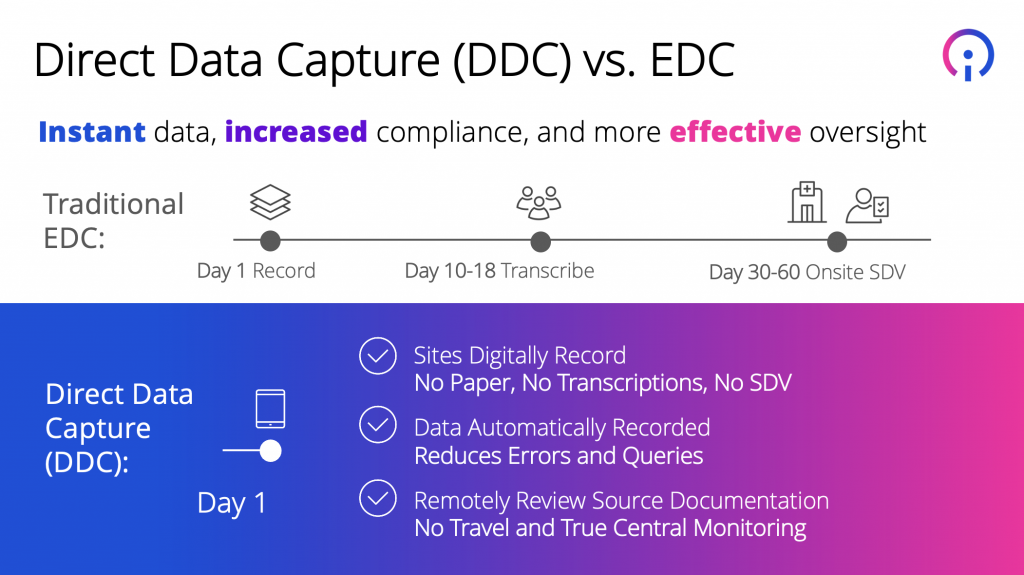
· Reduced administrative burden. There are no paper-based sources and no need for transcription. This eliminates duplicate efforts, requires no source data verification (SDV), and results in dramatically fewer data queries.
· Support for a patient-centered journey. All data points from patients are captured directly, in real-time.
· Improved visibility and management of data. This extends across visits, devices, sensors, telemedicine and digital health technologies and eliminates the delays and data inaccuracies associated with paper records.
· A cohesive audit trail across systems, users, and data sources.
· Compliant long-term storage. Trial data can easily be stored and results duplicated for as many years as required by regulators.
Sponsors, for their part, will enjoy:
· Instant access to data for increased compliance and more effective oversight (as compared to an often 60-day time lag with data captured in EDC systems).
· Higher-quality data owing to fewer opportunities for human error.
· True central monitoring, as source documentation is reviewed remotely, eliminating the need for monitors to travel to sites.
· Improved compliance and pharmacovigilance. With data collected from any source and stored in one data set, research teams are empowered with real-time visibility and context for immediate monitoring that ensures patient safety and compliance with regulations.
· Peace of mind, knowing that they are making insight-based decisions from complete, timely, accurate trial data.
A Recommendation: Gradual Adoption
Considering that EDC systems are supporting trials that are underway and that adopting new technology requires an investment in software and training, it would be advisable for Sponsors to “sunset” EDCs over time, gradually converting to DDC for upcoming trials. Then, over time, as DDC is applied to all new trials, the old EDC systems will gradually be used in fewer and fewer trials and take their place in the technological dustbin.
Admittedly, even a gradual transition will call upon site staff to learn new software, but it will be a means to an end that portends dramatically less administrative work for sites and a better trial experience for all.
By Queen Adaugo Ohandjo, Ph.D, MSCR Founder, Proof Clinical ResearchSite & Patient Experience Advocate Operational efficiencies, when properly leveraged, are a key opportunity in clinical research to resolve bottlenecks in all aspects of clinical operations. For example, there are still operational inefficiencies with site-managed data synchronization, thus causing a break or bottleneck in the feedback chain. Fortunately, many technology partners are already doing their part in prioritizing operational efficiencies. Here at Proof Clinical Research, the operational efficiencies that we have experienced while advocating for patients and sites in the clinical industry are centered around patient data capture, shared investigators platforms and the digitalization of clinical trial documents like eProtocol, eConsent and eISF. The impact of these solutions and systems has helped to transcend the clinical research landscape, but a full-scope transformation is necessary if we are to create and sustain an inclusive and equitable clinical industry that transcends time. Establishing Efficient Clinical Workflows According to site and patient feedback received from our grassroots efforts, the consensus is that operational efficiencies should be defined by clinical workflows that enhance the survivability and successful outcome of clinical trials managed by site personnel. The Clinical Trials Operations Branch in the Office of Clinical Research at the NIMH developed a framework for assessing the operational complexity of clinical trials. This complexity is based on potential operational challenges presented in the planned research. According to NIMH, the goal of the assessment is to evaluate the operational aspects of a clinical trial in synchronization with the study team’s resources and capacity. In addition to successfully enrolling eligible participants in a study, a clinical trial relies on having enough retention of participants through study completion to have the statistical power to answer the proposed research questions. The Office of Clinical Research at the NIMH highlighted that there are numerous factors that contribute to study dropout and follow-up completion rates. Some factors are controlled by the study team while others factors are controlled by a population that is more clinically unstable than expected. The life cycle of clinical operations begins with patient engagement. All stakeholders should be mindful of what is being asked of clinical study participants in terms of the frequency and complexity of clinical procedures. This is a necessary step to assess if participants will be willing to enroll and remain engaged for the duration of a study. Data Collection & Management Another aspect of the operational evaluation relates to data collection, coordination, and management. A feedback loop is necessary in order to eliminate bottlenecks and redundancy. Ultimately, attracting and retaining participants in the research of new medicines, therapies and interventions are becoming an industry and non-industry-wide effort. We need not be complacent about integrating solutions from other industries in order to reach a wider audience whose attention and interest in clinical trials have been clouded with horrific and non-ethical experiences. Subsequently, a comprehensive operational review allows study teams to make more informed decisions about whether a team has the staffing, resources and procedures in place to run a trial successfully from inception. This informed decision should be substantiated with real-time reports from integrated and unified clinical platforms. By reviewing factors that contribute to operational efficiencies, sites and patients are better positioned to enhance the stewardship of the clinical trials it supports and participates in. The digitalization of clinical trial start-up processes into an integrated or unified clinical environment has resulted in favorable outcomes, however much more is needed to ensure a successful and positive patient recruitment experience. Unified platforms that connect patients, sites, sponsors, and partners in a secure and scalable cloud environment by reusing, recycling and standardizing data ultimately help to bring life-changing medicines to those who need them most. The objective is not unified vs integrated; the objective should be solutions that integrate all the functionalities required for a clinical study from planning to closeout. This includes, but is not limited to: a solution that facilitates hybrid, on-site, off-site and remote teamwork. a solution that is geo-regulatory compliant. a solution that is adaptable to epi-financial outliers. a solution that is built on intelligent reporting capabilities. a solution that incorporates natural language processing and cultural nuances. a solution with synchronized feedback into clinical workflows. Enabling Trial Diversity Furthermore, when utilized appropriately, we know that technology can be instrumental in accessing and managing a diverse patient representation in trials, but there are still lessons to be learned regarding how to better serve sites and patients in an inclusive manner. Discussions with patients and sites inform us that the digitization efforts have to expand beyond our clinical industry and begin to collaborate across non-clinical industries that share similar outcomes and patient profiles with clinical trials teams across the globe. The push for good medicines begins with a better understanding of the patient’s lifestyle, site-patient relationship, patient cultural awareness and community-centered participation. Partnership with communities and diverse patient representation are critical to earning and maintaining trust in the clinical research and healthcare industry. When diversity and inclusivity have been met, then ensuring positive community impact and equitable uptake of new medicines, therapies and interventions should be the primary objective of all clinical trial stakeholders. A community-centered participatory research (CCPR) approach that intentionally accounts for the social and local needs of engaged partners (patients and sites included) will be necessary to enhance and create solutions that prioritize operational efficiencies in a non-biased manner. A patient-recommended CCPR blueprint includes solutions integrated with: Cultural sensitivity & specificity: applications that enable and promote positive and effective interaction with diverse cultures. Knowledge training: applications that focus on providing patient and site partners with the content and process know-how needed to retain participants’ full and robust engagement in clinical research activities. Supportive measures: applications that provide facilitating tools, devices, platforms, or materials that support full engagement in clinical research activities. Clinical Research Sites & Patients Drive Intentional Changes There is a huge opportunity for site and patient advocates to educate stakeholders on what works well in the environment and community where research is being conducted. Sites are the epicenter of the clinical trial process. As a result, there is an opportunity for sites to drive intentional changes into sustainable and successful clinical operations. Site feedback on targeted outreach, opportunity marketing, inclusive applications, and participant selection processes creates a valuable atmosphere whether in an offsite, on-site, remote or hybrid setting. Site and patient advocates streamlining the message to all stakeholders through channels (such as advocacy channels, social network channels, and peer-to-peer channels) are necessary to reach underrepresented populations. In summary, there is a huge opportunity for site and patient advocates to educate stakeholders on what works well in the environment and community where research is being conducted. By working closely with advocacy and existing social network groups, key stakeholders begin to build trusted pillars within the community and engage with patients in the contexts that are familiar to them thus enhancing operational efficiencies and establishing clear practices for how the future of clinical research should be operationalized. For example, during the planning stage, the utilization of mobile and/or web applications that identify and test potential community outreach strategies, and develop peer /clinical navigator programs, community-centered practices and support resources should be integrated into unified platforms or serve as a stand-alone add-on. This approach will help identify and test potential operational strategies, identify bottlenecks and mitigate financial losses due to inconsistent forecasts well before millions of dollars are invested in a particular clinical study. References Sharon L. Smith, DNP; Galia Siegel, PhD; Ashley Kennedy, PhD. Assessing the Operational Complexity of a Clinical Trial: The Experience of the National Institute of Mental Health. Clinical Researcher—March 2020 (Volume 34, Issue 3) Elizabeth Cope, Ph.D., M.P.H. Prashila Dullabh, M.D. Michelle Johnston-Fleece, M.P.H. Claudia Grossmann, Ph.D. HSR Resources & Methods Research Ethics & Governance Patient & Consumer Engagement Health Equity. Mar 01, 2022 TransCelerate BioPharma Inc. Seven ways to diversify patient populations in clinical trials. https://www.transceleratebiopharmainc.com/seven-ways-to-diversify-patient-populations-in-clinical-trials/ 08/03/2021 Reeshav Mittal, BDS, CCRA, CCRP. Cloudbyz for Association of Clinical Research Professionals. Unified Clinical Trial Management Systems: What They Are, Why They Matter, How to Choose Them., March 30, 2022
By Rachel Baldwin, Associate Product Marketing Manager, Teckro When it comes to the importance of diversity, equity and inclusion (DEI), we all welcome the acceleration in global awareness and discussion. For the clinical research industry, finding common ground among sponsors, sites, patients and community advocates is a critical first step to expanding DEI conversations. Whether it’s reading a “good news” story or learning from things that missed the mark, one key factor is universally clear: it is paramount that those occupying underrepresented demographics and identities are central and present for the conversation. Finding Common Ground: Clinical Trial Inclusion from Perspectives of Sites and Patients is our most recent webinar hosted by the Society for Clinical Research Sites (SCRS). Teckro’s own Director of Site Engagement Silvina Baudino was joined by Luckie Alexander, founder of Invisible Men and LGBTQ+ advocate, and Chris Komelasky CEO and co-founder of SiteBridge Research. Silvina, Luckie and Chris explored topics including: The multidimensional approach needed to achieve true diversity, equity, and inclusion Specific LGBTQ+ community barriers to clinical research participation What clinical research sites are doing now and could be doing in the future What further meaningful actions can improve inclusion of traditionally underserved patient communities in clinical research Centering Intersectionality Silvina started by outlining the current clinical trial industry state of affairs. The most recent draft guidance from the FDA on equitable participation for individuals from underrepresented racial and ethnic populations is an excellent step and will help to move the needle. However, we need to remember that people are multidimensional and often occupy intersecting identities. Particularly if we consider the LGBTQ+ community, they are often only considered for clinical research around HIV and sexual health, which limits engagement and overlooks clinical trials as a care option for other conditions and disease areas. Silvina also discussed findings in a report published by Teckro of experiences and interactions with clinical research and healthcare shared by LGBTQ+ patients and community members, which is the result from a virtual advisory meeting facilitated with the Center for Information and Study on Clinical Research Participation (CISCRP). The report also explores the insights and recommendations for improving future patient experiences in clinical trials. As both an LGBTQ+ patient and community member as well as a clinical trial recruiter, Luckie has an interesting insight into both sides of the study participation coin. Luckie was one of the advisors in the LGBTQ+ focus group hosted by CISCRP. He shared that for trans or LGBTQ+ folks, language and awareness of unique challenges are key to increasing trust. Gendered language excludes members of these communities by default, for example “women’s health” topics fail to account for trans men who could still be impacted by and/or need treatment for reproductive health issues. Luckie has found in his role of recruiting patients that even as a community member and trusted messenger, people are still hesitant to participate in clinical research. The starting point for many DEI initiatives has been heavily centered around race and ethnicity. While this is not a bad thing, a visible gap has existed for decades with a history of poor access and equity issues across many communities. The panel discussed how it is important not to pause at one identity, to be intentional, and to continually consider intersectionality. Download the report. Community Engagement: Not Another Term for Patient Recruitment Another hot topic is authenticity. It’s widely recognized that popping up in community spaces and just attempting to recruit clinical trial participants off the bat has been poorly received and largely unsuccessful. From the site perspective, Chris discussed the transactional nature of participant quotas and breaking the paradigm of study specific recruitment. SiteBridge Research’s framework for community engagement strategies focuses on sustained connectivity and trust. As ever, listening is key. Chris expanded on the need to be early, authentic and consistent when engaging with a community, and to do so in a broader, omnipresent manner – not as a specific, budget-constrained, outreach for an individual study. This supports an impactful network approach before studies even happen and builds roots and trust in those communities ahead of time. SiteBridge Research offers a toolkit for talking about clinical research, and also has a Champion Program, where champions help dispel misinformation, provide education and strengthen community connections. The toolkit packages general disease guidance, health literacy and clinical trial information and can be shared with community leaders for dissemination. Assorted industry partners, such as CISCRP and Greater Gift, are working with SiteBridge Research to develop accessible, adaptable, multilingual content across these areas. With a continued reach, a champion network can be enabled and empowered. Community engagement should not be seen as another term for patient recruitment. Alongside using digital and virtual channels for raising awareness and disseminating information, there should be genuine, value-adding contributions in a face-to-face setting before recruitment is even on the table. This includes a presence at local events and activities, physical boots on the ground offering health information, and a safe place for questions and honest conversation. Later down the line, when trust has been earned, relationships fostered, and communication lines established, members of that community may be more receptive to clinical research as a care option and consider participating in clinical trials. Following that is when outreach may be enhanced with community advocates that help with spreading awareness. Individual and Organizational Responsibility With many DEI conversations and initiatives, there is an understanding that people can be afraid of saying the wrong thing, for example when interacting with or addressing an individual from the LGBTQ+ community, and that this may make some physicians or healthcare providers avoidant. The panel talked about individual and organizational level responsibility. Luckie shared his view that for a relationship with a healthcare provider to be both positive and feel safe, physicians need to take personal responsibility to learn about and engage with different communities to truly understand what they’re going through and what they need. At an organizational level, the key responsibility is to ensure feedback and input are captured from across an intersectional breadth of different communities and built into the trial design and study protocol. Additionally, there needs to be an embedded understanding of and commitment to diversity, equity and inclusion in the organizational culture. This includes providing staff DEI training and ensuring there are no barriers to organizational staffing opportunities for individuals or physicians from across diverse communities. Luckie further shared that while there are specific perspectives and nuances within different communities, what cannot be lost is the commonality of everyone just wanting respect. Communities talk to each other and while good news travels fast, bad news travels faster. If respect for all is embedded at the very core of an organization, then it will be known for being a safe space and the likelihood of positive community engagement is exponentially increased. Meet Teckro at booth #28 at the SCRS Diversity Site Solutions Summit, March 30-31, 2023, in Austin TX.