info@myscrs.org
    • Join SCRS
    • Member Login
    Search
    Menu
    • About
      • Welcome to the Society for Clinical Research Sites

        About SCRS

        The advocacy organization representing the voices of global research sites.

        Meet the Team

        The people behind SCRS.

        Leadership Council

        The leaders providing guidance and oversight to SCRS.

    • Membership
      • Become a Member

        Join SCRS

        The global community for research sites. Explore SCRS membership benefits.

        Member Portal Login

        Access resources, events, and communities built for members.

    • Partners
      • Corporate & Global Impact Partners

        Industry partners aligned with SCRS to support site sustainability.

        Partner with SCRS

        Explore how to support SCRS programs or showcase your organization through events.

    • Advocacy
      • Digital Innovation

        Education and training on decentralized clinical trials (DCTs) and emerging clinical technologies.

        Cut>25 Training

        Industry-wide effort to reduce site training requirements.

        IncluDE Program

        Supporting clinical research that reflects all communities.

        Demographic Site Assessment Tool

        Oncology Program

        Empowers clinical research sites as essential partners in the cancer research ecosystem.

        Oncology Trial Phase 1 Resources

        Payment Initiative

        Addresses financial burdens for research sites and study participants.

        Site Advocacy Groups

        Sites and industry in dialogue to improve clinical research processes, tools, and partnerships.

        Collaborate Forward

        Exploring best practices to close collaboration gaps across clinical research.

        Get Involved

        Volunteer to participate in SCRS programs and initiatives.

        2026 Landscape Survey

        Shape the future of clinical research by providing critical data on industry operations, finances, staffing, technology, and partnerships.

    • Events
      • Site Solutions Summits

        Australia-New Zealand

        Europe

        Global

        Latin America

        West

        Ambassador Program

        Serving Africa, Asia and Latin America

        Webinars
        Workshops
    • Resources & Training
      • Podcast

        SCRS Talks Podcast

        Submission Form

        Publications

        White Papers

        InFocus Newsletter

        Press

        Training

        Good Clinical Practice (GCP) Training

        Learn more about free GCP training available to SCRS members.

        Site Management Modules

        Free clinical research training modules.

        Recist Training Modules

        Oncology training for site staff.

        Webinar Access

        Register for upcoming webinars or watch recordings on demand.

    Search
    START TYPING AND PRESS ENTER TO SEARCH
    • About
      • Welcome to the Society for Clinical Research Sites

        About SCRS

        The advocacy organization representing the voices of global research sites.

        Meet the Team

        The people behind SCRS.

        Leadership Council

        The leaders providing guidance and oversight to SCRS.

    • Membership
      • Become a Member

        Join SCRS

        The global community for research sites. Explore SCRS membership benefits.

        Member Portal Login

        Access resources, events, and communities built for members.

    • Partners
      • Corporate & Global Impact Partners

        Industry partners aligned with SCRS to support site sustainability.

        Partner with SCRS

        Explore how to support SCRS programs or showcase your organization through events.

    • Advocacy
      • Digital Innovation

        Education and training on decentralized clinical trials (DCTs) and emerging clinical technologies.

        Cut>25 Training

        Industry-wide effort to reduce site training requirements.

        IncluDE Program

        Supporting clinical research that reflects all communities.

        Demographic Site Assessment Tool

        Oncology Program

        Empowers clinical research sites as essential partners in the cancer research ecosystem.

        Oncology Trial Phase 1 Resources

        Payment Initiative

        Addresses financial burdens for research sites and study participants.

        Site Advocacy Groups

        Sites and industry in dialogue to improve clinical research processes, tools, and partnerships.

        Collaborate Forward

        Exploring best practices to close collaboration gaps across clinical research.

        Get Involved

        Volunteer to participate in SCRS programs and initiatives.

        2026 Landscape Survey

        Shape the future of clinical research by providing critical data on industry operations, finances, staffing, technology, and partnerships.

    • Events
      • Site Solutions Summits

        Australia-New Zealand

        Europe

        Global

        Latin America

        West

        Ambassador Program

        Serving Africa, Asia and Latin America

        Webinars
        Workshops
    • Resources & Training
      • Podcast

        SCRS Talks Podcast

        Submission Form

        Publications

        White Papers

        InFocus Newsletter

        Press

        Training

        Good Clinical Practice (GCP) Training

        Learn more about free GCP training available to SCRS members.

        Site Management Modules

        Free clinical research training modules.

        Recist Training Modules

        Oncology training for site staff.

        Webinar Access

        Register for upcoming webinars or watch recordings on demand.

    • info@myscrs.org
    • Join SCRS
    • Member Login
    SCRS LogoSCRS LogoSCRS LogoSCRS Logo
    • About
      • About
    • Membership
      • Membership
    • Partners
      • Partnerships
    • Advocacy
      • Advocacy
    • Events
      • Events
    • Resources & Training
      • Resources & Training
    ✕
    • Home
    • Blog
    • Resources
    • How to Make Patient-Centricity Work Better for Sites and Sponsors
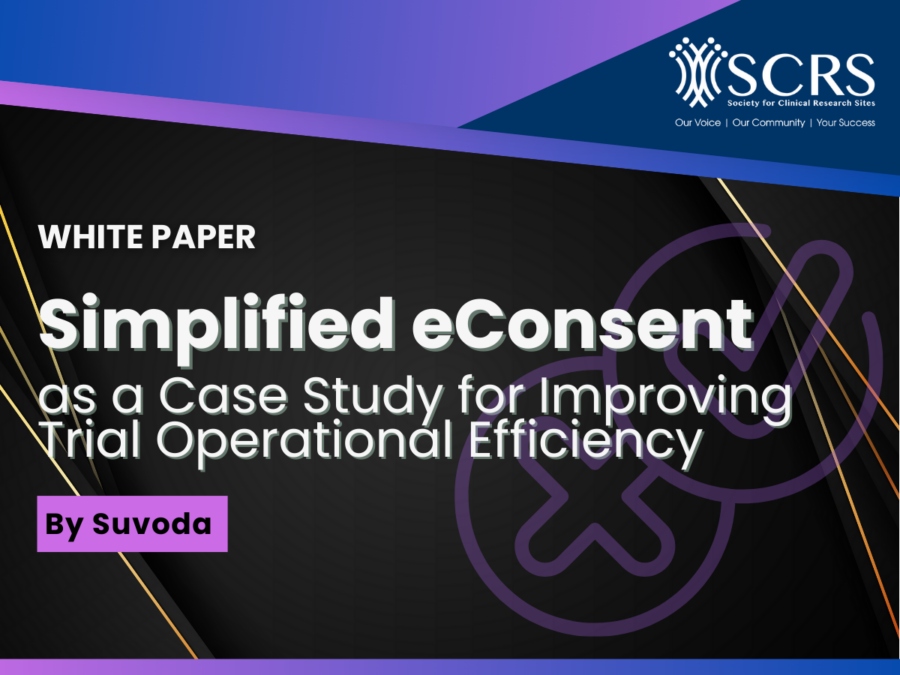
    How to Make Patient-Centricity Work Better for Sites and Sponsors

    February 7, 2025

    Our lives have become more digital by the day. This is especially true in the healthcare space, where developing digital solutions to replace outdated paper processes increases efficiency across the industry.  

    Decentralization has become a hot topic in healthcare, yet despite being a buzzword in recent years, decentralization has been revolutionizing the clinical trial space since well before the pandemic.  

    Technologies such as patient payments, electronic clinical outcome assessments (eCOA), and electronic data capture (EDC) have all been developed to optimize clinical trial operations. However, there is still a technological gap in consent management for patients, sites, and sponsors.  

    Despite the significant potential of eConsent solutions to dramatically improve the informed consent process, it is crucial to consider their integration with existing clinical trial tools. Proper integrations can simplify workflow for patients, sites, and sponsors, rather than complicate them.  

    Complacency with burdensome paper processes

    To understand the need for a patient-centric eConsent solution, we must first understand the paper process of informed consent — including the challenges and consequences that come with it. 

    Paper consent documents are often lengthy and laden with legal jargon, making it difficult for patients to read and fully understand the terms of their participation in a trial.  

    For sites, sponsors, and Clinical Research Organizations (CROs), this manual process creates a cumbersome paper trail with no real-time information on consent status or enrollment information by site. Furthermore, separate consent forms for different countries and languages, version control, and protocol amendments all make paper consent inflexible, operationally challenging, and burdensome.  

    These complexities risk inadequate patient information and comprehension, errors at sites, or even compromising entire studies. So, why do stakeholders persist with paper consent despite these drawbacks? Trust. 

    The familiarity with paper consent leads stakeholders to accept its consequences — sponsors reluctant to impose new processes on sites, site personnel accustomed to using paper, and patients’ trust in paper consent can all lead to resistance against new technologies.  

    However, the demand for a simplified informed consent process exists, and will inevitably increase as more people are exposed to eConsent as a solution, just as it has in banking and other highly-regulated industries.  

    According to Suvoda’s recent general population survey on awareness of eConsent and digital signatures, 50.2% of US respondents actually prefer to sign electronically (either at home or on-site).1

    Simplified, patient-centric solutions can address the problems in manual processes that many have grown accustomed to while also building trust that the solution works as it is designed to — without overwhelming the patient. 

    Meeting sites and patients where they are

    Like other areas of technological innovation, clinical trial decentralization aims to address the burdens and errors associated with manual processes without introducing new complexities. To accomplish this, we need to consider existing burdens on the coordinator, the investigator, and most importantly, the patient.  

    Simplified eConsent solutions are inherently patient-centric because they take into account the challenges of the end user while also making patients feel like humans rather than just another number. For example, a recent JAMA study found that improving the readability of informed consent documents — something that eConsent achieves — could increase patient accessibility.2  

    More recently, consumers are taking in information in short, comprehensive clips, like 30-second TikTok videos. In the near future, patients and participants could feel more comfortable through the use of embedded videos, or the use of AI to summarize or highlight terms and provide definitions as they read the document.  

    These technologies help return some of that power back to patients and their families, ensuring they understand what it is they are consenting to in a clearer manner. In addition to accounting for the challenges, simplified solutions give more time for investigators to focus on what matters — getting lifesaving treatments to patients faster. 

    Practical innovation prioritizes accessibility 

    Suvoda’s technology is aimed at harnessing complexity to improve clinical trials, rather than adding to it for the sake of innovation. Our approach revolves around two core principles: simplifying the innovation process and creating a unified, patient-centric ecosystem that seamlessly integrates within other eClinical tools. 

    When it comes to innovation, it’s what you take out that matters. Simplifying a technological solution demands a concerted effort to self-edit to avoid overwhelming users.  

    By identifying the issues with paper consent, guided the creation of a unified ecosystem with Suvoda eConsent— one that is elegant to manage, offers high visibility and control, and unparalleled speed and flexibility while leveraging the accessibility benefits of other decentralization tools. 

    When eConsent integrates with IRT, it creates a virtual “gate” so that only patients who have signed the latest consent forms are dispensed the drug — simultaneously protecting patients while reducing friction for sites and sponsors. Instead of attempting to only refine the informed consent process, Suvoda introduced a patient-centered solution coupled with administrative tools, encouraging broader adoption of eConsent. 

    Introducing new solutions to people doesn’t have to be an uphill battle if innovation is refocused on simplicity and patient-centricity. At the end of the day, we are here for patients — only when we all work together to better guide and influence our innovation will we be able to take the steps toward a better way.  


    By Andrés Escallón Vice President, eCOA Solutions, Suvoda


    Sources

    1Survey From Suvoda Shows Comfort with Electronic Signatures is on the Rise, Yet Healthcare Consent Still Lags.” Suvoda, April 2023.  https://www.suvoda.com/insights/all-news/survey-shows-comfort-with-electronic-signatures

    2Ezekiel J. Emanuel and Connor W. Boyle, “Assessment of Length and Readability of Informed Consent Documents for COVID-19 Vaccine Trials,” JAMA Network Open 4, no. 4 (April 28, 2021), https://doi.org/10.1001/jamanetworkopen.2021.10843
     

    Download


    Share

    Related posts

    April 27, 2026

    Leading the Cut: 4 Organizations Take on Site Training Reduction


    Read more
    April 24, 2026

    Behind the Budget: What Sites Really Need to Know Today


    Read more
    photo of different gear icons titled "why site support goes unused in clinical trials"
    April 24, 2026

    Why Site Support Goes Unused in Clinical Trials


    Read more

    info@myscrs.org

    SOCIAL


    Join Today
    Join a Summit
    © 2024, SCRS, all rights reserved. | Designed by Baltimore Web Design

    Policies | Terms of Use

      • Join SCRS
      • Member Login